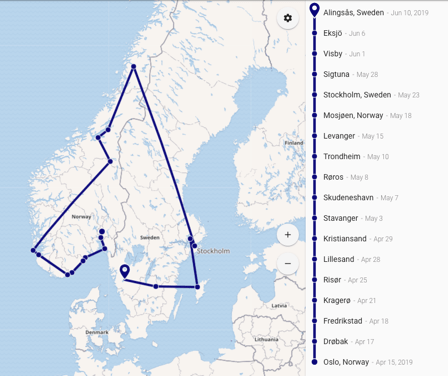
Research Interest: A survey of the current status and future trajectory of preservation in selected historic wooden towns will inform research on historic district development and heritage building preservation in a denser urban context, while providing insight into public perception of cultural heritage significance.
INTRODUCTION:
Significant elements of the history and development of Scandinavia and much of the world are intrinsically linked to urban areas. Throughout the Nordic region, modern cities reveal their origins, which can be as long ago as the Middle Ages, in the form of buildings, public space, and the environment. The cultural heritage evident in cities is a key component to cultural identity and city character for both residents and visitors. However, in a region with over 1,000 years of history, many vernacular and “recent past” buildings remain unprotected.
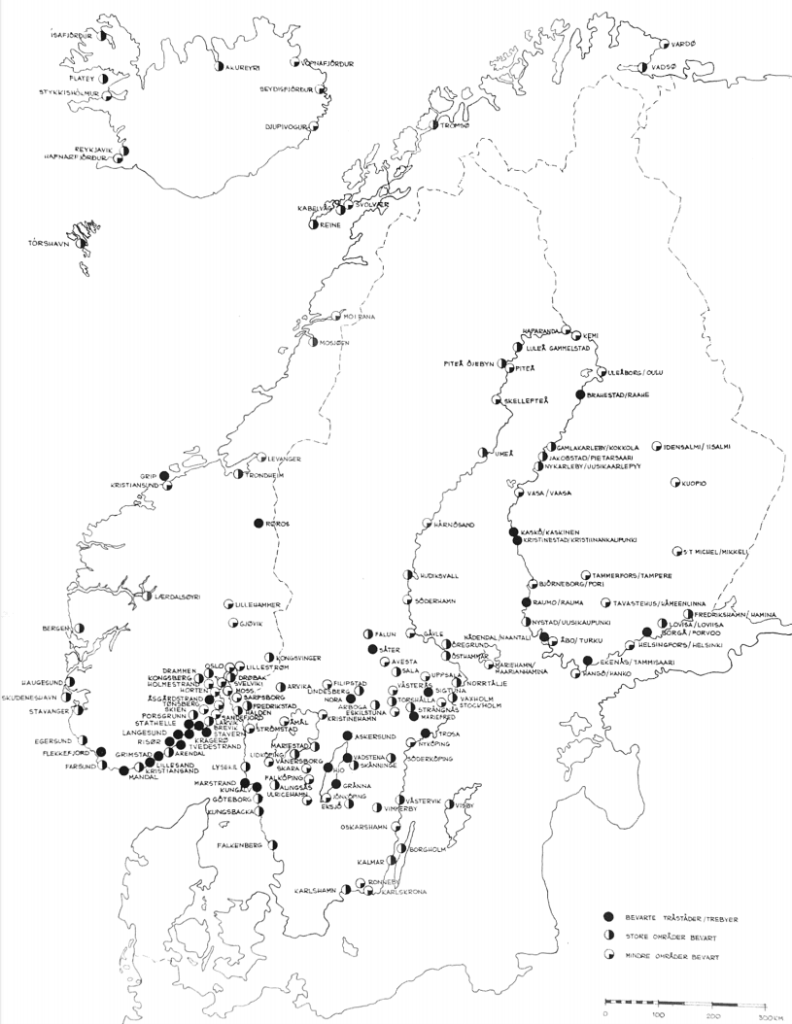
In 1975, The European Charter of the Architectural Heritage was adopted which made a call for “lesser” artifacts of cultural heritage to be integrated into current conservation efforts1. Many smaller historic towns in Norway and western Sweden contained intact, functioning examples of 19th century life, but were not recognized as having or contributing value to Nordic heritage. These mid- to small-size towns in many cases presented entire districts of vernacular buildings; merchant and retail buildings, port and industry structures, and housing, all of typical wood construction. Forty years after the charter adoption, many towns representative of den Nordiska Trästaden2 (the Nordic historic wooden town) still have a cultural building repository but with varying levels of implementation of preservation laws and protection.3
At present day, a cooperative of Nordic countries have recently created a network of municipalities to celebrate their historic city centers built from wood, revitalizing the 1975 charter’s original goals. The Nätverket den Nordiska Trästaden (Nordic Wooden Town Network)4 educates both administrators and residents about local cultural heritage through conferences and outreach. The Nätverket also promotes their member towns as sought-after real estate and tourism destinations, but as towns become more popular development will surely increase. Questions remain as to how many of these towns will plan for urban growth and a denser future, while maintaining their historic urban fabric. With a direct relation to several of Seattle’s most pressing issues of growth, densification, and the growing debate on the justification of heritage building preservation, Sweden and Norway’s historic wooden cities provide a window into preservation tactics in cities of all sizes and at varying stages of historic status.
CURRENT STATUS:
Both Sweden and Norway are experiencing unprecedented growth, with densification increases of 30% expected in several cities by 20307. They, too, are experiencing a housing shortage which when competing with heritage buildings for property, can create an emotional dialogue about justification. The anticipation of increased populations has led Seattle to upzoning and densifying many core neighborhoods that contain vernacular, historical buildings. I am very interested in learning if Norway and Sweden are planning to modify their urban fabric in a similar fashion or in such a way that preserves heritage buildings while being sympathetic to the needs of a growing city.
Counties or fylkes in Norway each have a department for cultural heritage or kulturminner, so preservation in many towns comes as a trickle-down effect of national politics to locate and designate cultural properties. Few towns have experienced grassroots efforts to preserve and maintain their heritage buildings, but of the towns that have, like Mosjøen, it will be insightful to understand the different processes behind community-led versus municipal efforts. I have reached out to many of the counties that I would be visiting and the three that have responded so far are excited to meet and discuss the subject of districts and density.
OUTCOMES:
The evaluation of successful historic districts in Sweden and Norway and my experience in reviewing individual building nominations will aid the development of my thesis project throughout the second year of my M.Arch program.
Preservation is not only about keeping a building standing, but also shifting the discourse to value cultural heritage. I would like to see a future in which buildings, public spaces, and environments can be preserved and contribute to a dense city with accessible living and working opportunities.
NOTES:
1 European Charter of the Architectural Heritage passed by the Council of Europe in 1975. https://www.icomos.org/en/resources/charters-and-texts/179-articles-en-francais/ressources/charters-and-standards/170-european-charter-of-the-architectural-heritage.
2Also: Nordisk treby (N), bindingsværksbyen (D), or Pohjoismainen puukaupunki verkosto (FIN).
3Torill Nyseth, Johanne Sognnæs. Preservation of old towns in Norway: Heritage discourses, community processes and the new cultural economy. Cities, Volume 31, 2013, Pages 69-75.
4Nätverket den Nordiska Trästaden. http://www.Nordisktreby.org.
 Nordic Vernacular Preservation: A Travel Blog
You must be logged in to post a comment.